

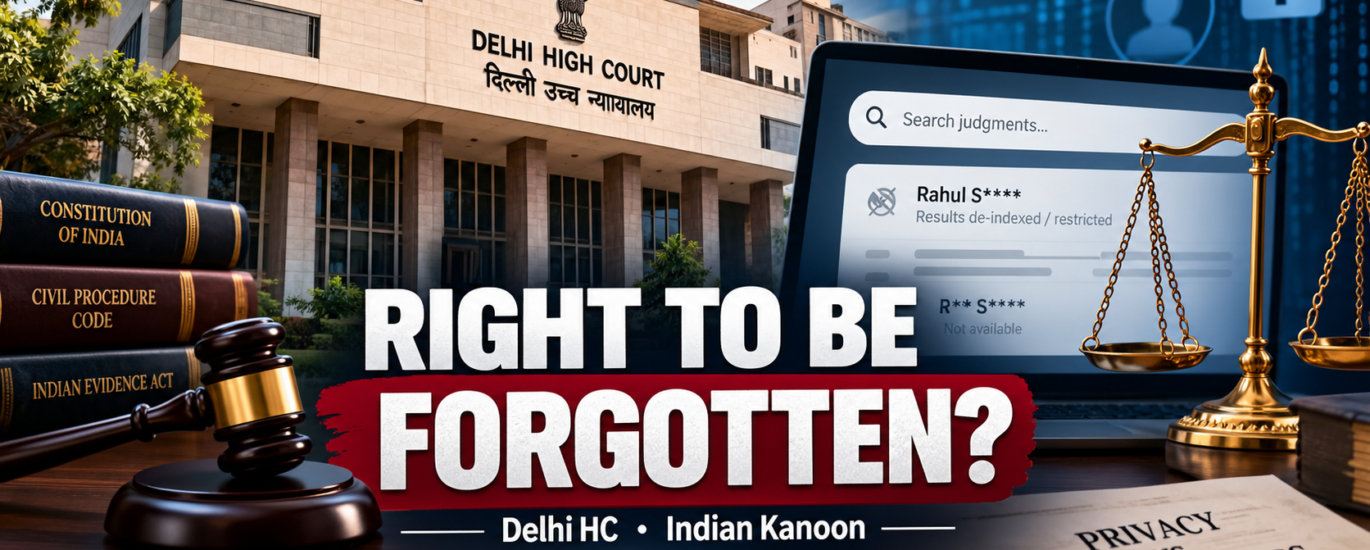
New Delhi, September 17, 2026: The Delhi High Court has raised important questions about the balance between the Right to Be Forgotten and public access to judicial records, with particular focus on the accessibility of legal research.
During the hearing of appeals concerning Indian Kanoon, a Division Bench observed that a large number of lawyers may not be in a position to afford subscriptions to expensive commercial legal research platforms and therefore depend on freely accessible legal databases for researching judgments.
Justice C. Hari Shankar and Justice Vinod Kumar are hearing appeals filed by Indian Kanoon in a dispute arising from a single-judge judgment concerning the removal, masking or de-indexing of personal information from online judicial records in certain circumstances.
The case brings into focus a broader question: If a judgment becomes difficult to find through a person’s name on free legal databases, does that create a practical barrier to legal research for lawyers who cannot afford paid databases?
Indian Kanoon and the Accessibility of Legal Research
During the proceedings, the Bench reportedly expressed concern over the accessibility of judicial information for lawyers across the country.
The legal profession is not limited to lawyers working at large corporate firms or organisations with access to expensive research services. Thousands of advocates, particularly those practising in district courts and smaller cities, may rely on freely available platforms to locate judgments and conduct legal research.
Commercial databases such as SCC Online and Manupatra offer extensive legal research facilities, but their subscription costs may not be equally accessible to every practitioner.
This has raised a practical issue in the Indian Kanoon case. If a judgment is removed from name-based search results and locating it requires access to a paid database, lawyers without such subscriptions could face greater difficulty in discovering the judgment.
The issue therefore goes beyond the operation of a particular legal database. It concerns how easily members of the legal profession can discover and access judicial decisions.
Right to Be Forgotten vs. Open Access to Judgments
The dispute involves competing legal considerations.
On one side is an individual’s interest in privacy, dignity, reputation and informational autonomy. On the other are principles associated with open justice, transparency, public access to judicial records and effective legal research.
The single-judge judgment recognised the Right to Be Forgotten in the context of informational privacy and laid down a framework under which personal information in online versions of judicial records could, in appropriate circumstances, be masked or de-indexed.
Importantly, such protection does not necessarily mean that the underlying judicial record is destroyed. The original, unredacted court record can remain preserved within the judicial system while access to certain information on public digital platforms is restricted.
This distinction is central to the Indian Kanoon appeals.
Why Name-Based Search Matters to Lawyers
One issue that has received attention during the proceedings is whether a judgment can simply be located through alternative information such as its case number or date after name-based search is restricted.
The Bench questioned the practical effectiveness of such an approach.
A lawyer may know that a particular judgment exists without necessarily remembering its case number. In many instances, judgments are discovered through the names of parties, advocates, individuals or other terms appearing in the case.
For legal researchers, name-based search can therefore be an important method of discovering relevant precedents.
If that search mechanism is removed, the judgment may technically remain available while becoming substantially harder to discover.
That distinction between availability and discoverability is one of the important issues emerging from the case.
The Privacy Concerns Behind the Right to Be Forgotten
At the same time, the privacy concerns underlying the Right to Be Forgotten cannot be overlooked.
A person’s name may remain searchable online for years after the conclusion of a case. This can become particularly significant where a person was acquitted, discharged, or was otherwise involved in litigation that no longer has continuing relevance to their life.
The argument in favour of privacy protection is that continued online association with old judicial proceedings can have consequences for an individual’s reputation and personal life.
The broader legal question is therefore not simply whether judgments should remain publicly accessible.
It is where the law should draw the line between the public’s interest in accessing judicial information and an individual’s interest in limiting the continuing digital exposure of personal information.
Does the Right to Be Forgotten Mean a Judgment Is Deleted?
Not necessarily.
The Right to Be Forgotten, particularly in the context of judicial records, does not automatically mean that a judgment is physically erased from the court’s records.
The framework discussed in the Delhi High Court proceedings involves concepts such as masking and de-indexing, which can restrict how personal information appears in publicly accessible digital versions of records.
The original judicial record may continue to exist even where certain information is no longer readily searchable online.
This creates an important distinction:
- Preservation of the judicial record — the original court record remains available within the judicial system.
- Public digital access — certain information may be masked or restricted.
- Searchability — the judgment may become more difficult to locate through conventional name-based searches.
It is the third aspect—searchability and discoverability—that has particular significance for Indian Kanoon and legal researchers.
Why the Indian Kanoon Case Matters
The proceedings have brought together two important dimensions of India’s digital legal ecosystem.
The first is the growing recognition of informational privacy and the Right to Be Forgotten.
The second is the importance of open and affordable access to judicial decisions.
For lawyers, researchers and litigants, access to judgments is not merely a matter of convenience. The ability to discover previous decisions can directly affect legal research and the preparation of cases.
At the same time, unrestricted online searchability of personal information can have lasting consequences for individuals whose names appear in judicial proceedings.
The Indian Kanoon case therefore raises a larger question about how courts should balance these interests in an increasingly digital judicial environment.
What Happens Next in the Delhi High Court?
The Indian Kanoon appeals are continuing before the Delhi High Court.
The proceedings have highlighted concerns about the practical consequences of restricting name-based access to judgments, particularly for lawyers who rely on free legal research platforms.
The next hearing is scheduled for September 21, 2026.
The further proceedings may provide greater clarity on how the Right to Be Forgotten should operate in relation to publicly accessible judicial records and whether safeguards are necessary to ensure that privacy protections do not create disproportionate barriers to legal research.
Conclusion
The Indian Kanoon vs. Right to Be Forgotten dispute raises questions that extend well beyond a single legal database.
At its core is a difficult balance between two legitimate interests: an individual’s right to privacy and protection from continuing digital exposure, and the public interest in open justice, transparent judicial records and accessible legal research.
The Delhi High Court’s observations about lawyers who cannot afford paid legal databases bring an additional dimension to the debate.
If a judgment remains technically available but becomes difficult to discover through free platforms, the question is whether that amounts to meaningful access in practice.
The outcome of the Indian Kanoon appeals could therefore have implications for lawyers, legal researchers, litigants, online legal databases and the broader accessibility of India’s judicial records.
SEO Pack
SEO Title:
Delhi HC on Right to Be Forgotten: Indian Kanoon Case Raises Free Legal Research Concerns
Meta Description:
Delhi High Court’s Indian Kanoon case raises key questions on the Right to Be Forgotten, free legal research, name-based search, judicial records, privacy and open justice.
Focus Keyword:Delhi High Court Right to Be Forgotten Indian Kanoon
Secondary Keywords:
- Right to Be Forgotten India 2026
- Delhi High Court Right to Be Forgotten
- Indian Kanoon case
- Indian Kanoon Right to Be Forgotten
- Delhi HC judicial records
- Right to Privacy Article 21
- legal research India
- free legal databases India
- SCC Online
- Manupatra
- de-indexing judicial records
- masking judicial records
- name-based search judgments
- open justice India
- access to judicial judgments
Suggested URL Slug:/delhi-high-court-right-to-be-forgotten-indian-kanoon-case/
Suggested Tags:Delhi High Court, Indian Kanoon, Right to Be Forgotten, Right to Privacy, Article 21, Legal News, Judicial Records, Legal Research, SCC Online, Manupatra, Open Justice
Backlink-Friendly Content Ideas
The article can naturally link to related evergreen or explanatory content using contextual anchor text, such as:
- Right to Be Forgotten in India — background and legal development
- Article 21 and the Right to Privacy — constitutional framework
- Delhi High Court Judgments — related judgments and decisions
- Indian Kanoon Legal Research Guide — how to search judgments effectively
- Open Justice in India — access and transparency in the judicial system
- Digital Privacy and Judicial Records — privacy concerns surrounding online court records
The links should be genuinely relevant to the surrounding paragraph rather than inserted purely for keyword targeting.