
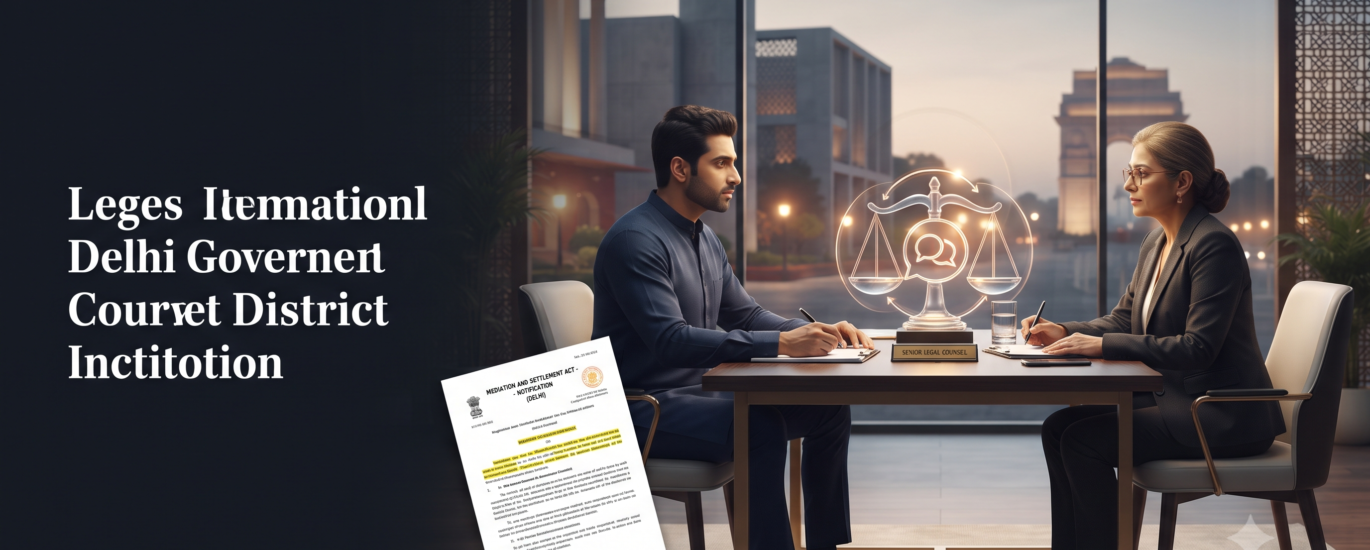
India has taken an important step towards strengthening its mediation framework with the establishment of the Mediation Council of India.
The Ministry of Law and Justice has issued a notification establishing the Council under the Mediation Act, 2023. Its head office will be located in Delhi. However, the Central Government has not yet appointed the seven members who will constitute the Council.
The development marks an important stage in India’s effort to promote mediation as an effective alternative to traditional litigation and build the country into a stronger domestic and international mediation centre.
What Is the Mediation Council of India?
The Mediation Council of India is a statutory body created under Section 31 of the Mediation Act, 2023.
The Mediation Act was notified on 15 September 2023 with the broader objective of promoting institutional and community mediation and encouraging the resolution of disputes without prolonged court proceedings.
The newly established Council is expected to play a central role in developing the country’s mediation ecosystem.
Its responsibilities will extend beyond merely facilitating dispute resolution. It will also be involved in setting standards, recognising mediation institutions, supporting mediator training and maintaining professional standards within the sector.
Seven-Member Council Yet to Be Appointed
Although the Central Government has now established the Mediation Council of India, the seven-member Council itself is yet to be appointed.
The appointment of its members will be an important next step because the statutory functions of the Council will need to be carried out through its constituted body.
Once operational, the Council is expected to oversee several aspects of mediation practice, including mediator registration, professional standards, training and institutional recognition.
Key Functions of the Mediation Council of India
The Council has been assigned a broad range of powers and responsibilities under the Mediation Act.
Promoting Domestic and International Mediation
One of its major objectives is to promote domestic as well as international mediation.
The government intends to develop India as a robust mediation destination, potentially strengthening India’s position in cross-border commercial and other disputes.
For businesses and parties involved in international transactions, a reliable mediation framework can provide an alternative to lengthy and expensive litigation.
Regulating Mediator Registration
The Council will also have an important role in establishing the framework for mediator registration.
It can lay down guidelines relating to:
- Education and training of mediators
- Assessment and certification
- Registration of mediators
- Renewal of registrations
- Professional standards
- Ethical conduct
The Council will also have powers to suspend or cancel mediator registrations where required under the applicable framework.
This regulatory role could help establish greater consistency and professional accountability in the mediation sector.
Recognition of Mediation Institutes
Training and professional education will be another major area of responsibility.
The Council is required to recognise mediation institutes that undertake programmes for training and educating mediators.
This could help create more structured pathways for individuals seeking to enter or develop a career in mediation.
Standardised training and recognition may also contribute to greater public confidence in professional mediators.
Ethical Standards for Mediators
Mediation depends heavily on trust, neutrality and confidentiality.
The Mediation Council will therefore have a role in establishing standards of ethical conduct for mediators.
Such standards can help address issues concerning professional behaviour and maintain confidence among parties who choose mediation to resolve their disputes.
Training, Workshops and Expert Committees
The Council can also organise training workshops and other programmes aimed at improving mediation skills and awareness.
It may further appoint committees of experts to assist it in carrying out its statutory duties and functions.
This provides the Council with a mechanism to seek specialised assistance on technical, legal and professional issues relating to mediation.
International Cooperation
Another significant aspect of the Council’s mandate is its ability to partner with international bodies and institutions.
International cooperation could become particularly relevant as India seeks to strengthen its position as a destination for commercial and cross-border mediation.
A credible mediation ecosystem, supported by professional standards and international engagement, could make India more attractive for parties looking for alternatives to conventional dispute resolution.
Why Is the Mediation Council Important?
Indian courts continue to deal with substantial litigation across civil, commercial, family and other categories of disputes.
Mediation offers parties an opportunity to resolve disputes through a structured process with the assistance of a neutral mediator, rather than depending entirely on adversarial court proceedings.
The establishment of a dedicated statutory council is therefore significant because it creates an institutional mechanism for developing and professionalising mediation in India.
The long-term objective is not simply to reduce the number of cases reaching courts. It is also to encourage a culture of negotiated dispute resolution where appropriate.
What Does This Mean for Lawyers and Mediators?
The new framework is particularly relevant for advocates, aspiring mediators, mediation institutions and legal professionals working in dispute resolution.
As the Council becomes operational, its guidelines and regulatory framework are likely to become important for mediator education, certification, registration and professional conduct.
Law students and young legal professionals may also find mediation increasingly relevant as a specialised area of practice.
Annual Report to the Central Government
The Mediation Council of India will also be required to submit annual implementation reports to the Central Government.
Such reporting can provide a mechanism to assess how effectively the statutory framework is being implemented and identify areas requiring further development.
What Happens Next?
The immediate next step is the appointment of the seven members of the Mediation Council of India.
Once the Council is constituted and becomes operational, its regulations, guidelines and institutional framework will be important for understanding how mediation will develop under the Mediation Act, 2023.
For lawyers, mediators, businesses and ordinary citizens, the development signals that mediation is receiving a more structured institutional foundation at the national level.
Legal Drishti Take

legaldrishthi@gmail.comEdit Profile
The establishment of the Mediation Council of India is an important development in India’s alternative dispute resolution landscape.
The real impact, however, will depend on how effectively the Council is constituted and how its statutory responsibilities are implemented in practice.
If supported by credible training, transparent registration standards, strong ethical rules and effective institutional mediation, the Council could play a significant role in making mediation a more trusted and accessible option for dispute resolution in India.
For the legal community, the development also reinforces a broader shift towards ADR, negotiated settlements and efficient dispute resolution mechanisms.
Legal Drishti will continue to track developments relating to the Mediation Act, the constitution of the Mediation Council of India and the rules and guidelines that follow.