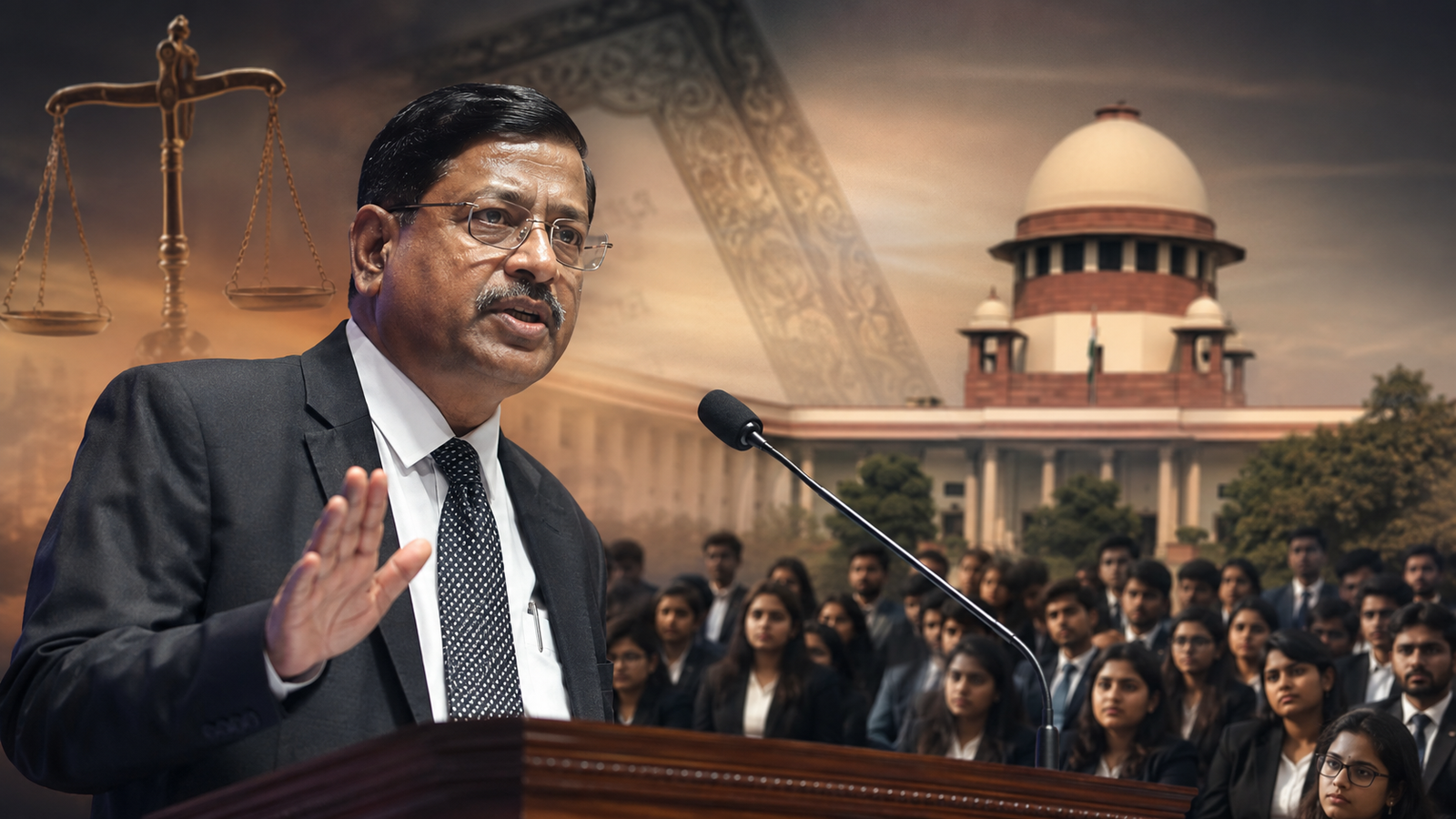



Bhopal, July 26: Supreme Court Justice Ujjal Bhuyan has voiced concern over what he believes is a growing trend of criminal cases being filed against people for exercising their right to protest or express opinions.
Speaking at a memorial lecture at the National Law Institute University (NLIU) in Bhopal on Saturday, Justice Bhuyan said that while courts do eventually step in to protect individual rights, the relief often comes too late. He also questioned whether strict bail conditions imposed in such cases end up discouraging people from speaking out.
According to him, the space for expressing different views is gradually shrinking.
“Debate and dissent are the essence of democracy,” he said, adding that even ordinary activities are sometimes being treated as criminal offences.
One example he referred to was the recent arrest of a group of Muslim men who were taken into custody after breaking their Ramzan fast with chicken biryani on a boat in the Ganga.
“I am sure consuming chicken biryani is not an offence. There is no law prohibiting the consumption of chicken over the Ganga river,” Justice Bhuyan remarked. He pointed out that the men reportedly spent around three months in jail before they were granted relief.
He said such incidents raise serious questions about how criminal law is being used and whether citizens are being unnecessarily dragged into legal battles for actions that are not prohibited by law.
Justice Bhuyan also expressed concern over the conditions attached to bail in several cases. He noted that some people are barred from attending public meetings, posting on social media, or even travelling abroad after being released.
While courts may be granting bail, he said, such restrictions can have a chilling effect on free speech and peaceful protest.
The judge also referred to a case in which permission for a protest over the situation in Gaza was denied. He said he found it surprising that anyone should question why Indian citizens would want to protest over events taking place outside the country.
“There is no law that says you cannot protest for Gaza,” he observed, suggesting that peaceful demonstrations on international issues are also part of democratic expression.
Justice Bhuyan did not limit his remarks to the protection of civil liberties. He also spoke about the judiciary itself, saying judges should be open to criticism and self-reflection.
He told law students that judgments should be debated and, where necessary, criticised. According to him, questioning a judgment is not the same as attacking the judge who delivered it.
He encouraged students to study landmark rulings with a critical mind instead of accepting every decision at face value.
Ending his address, Justice Bhuyan said public trust is the true measure of the judiciary’s strength. Rather than judges praising their own institution, he said, it is the people who ultimately decide whether the courts continue to command respect and confidence.
He added that honest introspection and open discussion are essential if the judiciary is to remain independent, credible, and relevant in a democratic society.